
Fundamental Informatics and Information Technology
The bachelor’s programme “Fundamental Informatics and Information Technology” focuses on mathematical models, algorithms, technologies, environments and tools for developing complex software…
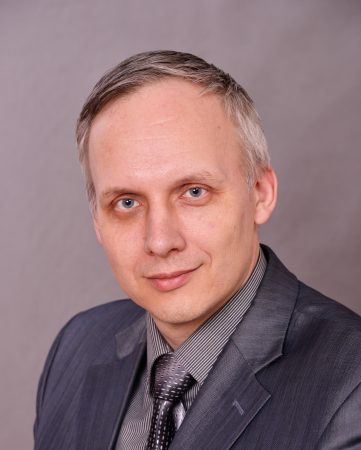
Konstantin Alexandrovich Barkalov
Doctor of Technical Sciences, Associate Professor, Professor of the Department of Software and Supercomputing Technologies, Institute of Information Technology, Mathematics and Mechanics
Faculty profile →About the programme
The bachelor’s programme “Fundamental Informatics and Information Technology” focuses on mathematical models, algorithms, technologies, environments and tools for developing complex software for high-performance computing.
The programme concentrates on systems programming, parallel computing, image processing and synthesis, computer vision, machine learning and data analysis.
Students gain knowledge and hands-on skills in parallel computing on a supercomputer. Lobachevsky University is one of the few universities with its own supercomputer available to students. The programme covers parallel programming for shared-memory systems, distributed-memory systems and graphics accelerators.
The computer vision course is taught by developers of the world-famous OpenCV library. It is part of the track for training top-level CV/ML engineers, which includes computer graphics, computer vision, scientific visualisation, classical machine learning, deep learning and artificial intelligence.
Teaching follows UNN’s own educational standard, included in the European register of engineering programmes accredited by the European Network for Accreditation of Engineering Education.
What will I study?
The programme combines a fundamental mathematical foundation with modern courses in programming, computer architecture, machine learning and high-performance computing.
Core mathematics 9
- Mathematical Analysis
- probability theory and mathematical statistics
- discrete mathematics
- computational methods
- differential equations
- algebra and geometry
- mathematical logic and theory of algorithms
- optimisation methods
- automata theory and formal languages
Programming and computing systems 9
- Programming Fundamentals
- algorithms and data structures
- operating systems
- mobile systems programming technology
- algorithms and complexity analysis
- database technologies
- distributed programming
- computer architecture
- introduction to compiler theory
Computer graphics, AI and high-performance computing 7
- Computer Graphics
- machine learning and data analysis
- parallel programming for cluster systems
- parallel programming for shared-memory systems
- computer vision
- scientific visualisation
- deep learning and artificial intelligence
Programme focus
Core mathematics
Mathematical Analysis, Probability Theory and Mathematical Statistics, Discrete Mathematics, Computational Methods
Programming and computing systems
Programming Fundamentals, Algorithms and Data Structures, Operating Systems, Mobile Systems Programming Technology
Computer graphics, AI and high-performance computing
Computer Graphics, Machine Learning and Data Analysis, Parallel Programming for Cluster Systems, Parallel Programming for Shared-Memory Systems
Internship
Internships take place in teaching and research laboratories, specialist departments, interdepartmental laboratories and research centres of ITMM.
From the third year, students can take part in a variety of R&D projects for commercial companies and government organisations.
Career paths
Software developer
Creates software products, services and tools for research and industry.
Software architect
Designs the structure of complex systems and chooses technologies for sustainable development.
Computer science researcher
Works with algorithms, models and experiments in computer science.
Where can I work?
Entrance exams
Russian language
Minimum score — 40
Mathematics
Minimum score — 40
Physics or Computer Science
Minimum scores: Physics — 41, Computer Science and ICT — 46
Apply now
Follow the button to the UNN Admissions Office website: deadlines, documents, admission rules and up-to-date information for applicants.